
Physicist, Theo Collaborators Program
First seen by Alion on Oct 1, 2026.
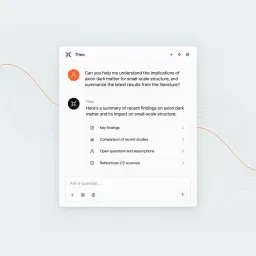
Overview:FirstPrinciples is an independent, non-profit research organization building Theo, the AI Physicist - an autonomous scientific system designed to reason about fundamental physics from first principles. Our long-term vision is to accelerate deep scientific discovery by combining machine reasoning with human scientific judgment.
As part of this effort, we are launching the Theo Collaborators Program: a small, selective group of expert physicists who will work with us to validate, guide, and stress-test the scientific reasoning produced by the AI Physicist in a focused research domain. This is not a tool evaluation program, and it is not a traditional advisory role. Collaborators engage with a concrete scientific direction, help assess whether the system’s reasoning is sound, and contribute to shaping what “good AI-generated physics” should look like.
The Theo Collaborators Program is open to late-stage PhD students, postdoctoral researchers, early-career faculty, and industry researchers with strong theoretical backgrounds.
We operate as a global nonprofit organization, with a Canadian foundation, a US-based 501(c)(3).
Current Scientific Focus (2026):For the initial phase, we are focused on Quantum Information Theory, with emphasis on narrow, formalizable sub-fields where rigorous reasoning and constraint-based results are possible.
Representative areas include:- Structural constraints in quantum LDPC codes
- Trade-offs between locality, rate, and distance in stabilizer codes
- No-go or impossibility results under fault-tolerance assumptions
- Information-theoretic bounds relevant to quantum error correction
- Fundamental limitations of decoding or logical operations
The goal is depth over breadth: producing AI-assisted theoretical results that are technically coherent, non-trivial, and respectable to the physics community.
What Theo Collaborators Do:Theo Collaborators engage at critical points in the research cycle:
Question Validation & Framing
- Review candidate research questions generated by the AI Physicist’s Question Formulator (QF)
- Help identify which questions are:
- scientifically meaningful;
- tractable;
- already resolved in the literature; or
- ill-posed.
- Provide feedback on assumptions, scope, and framing and help improve the Question Formulator module.
Shaping Question Ranking & Evaluation Criteria
- Help us refine how questions are ranked by:
- novelty;
- complexity;
- originality;
- tractability; and
- scientific relevance
- Contribute to defining what “interesting” and “non-trivial” should mean for the future autonomous scientific system.
This input directly informs how the AI Physicist prioritizes which questions to pursue deeply.
Scientific Validation of Research Outputs
- Review AI-generated research outputs (Dynamic Research Objects, or DROs) and assess whether they are:
- internally consistent
- mathematically sound
- properly grounded in the relevant literature; and
- aligned with accepted physical principles and assumptions
- Identify errors, gaps, or unclear reasoning, including points where assumptions are too strong, steps are missing, or conclusions are not adequately supported.
- In addition, help us identify where the AI Physicist’s scientific workflow falls short, including:
- limitations in hypothesis generation;
- missing or inadequate evaluation criteria;
- weaknesses in symbolic manipulations or formal reasoning; or
- additional modules and capabilities that would be required to make the reasoning more complete, rigorous, or reliable.
This feedback directly informs how we evolve the Theo’s architecture and helps ensure that its outputs meet the standards of serious theoretical physics.
What is a DRO?The primary scientific output of the AI Physicist is a Dynamic Research Object (DRO).
A DRO goes beyond a traditional paper and serves as a dynamic, traceable, and reproducible container that captures:
- the research question;
- assumptions and representations;
- hypotheses considered;
- reasoning paths explored;
- evaluations performed; and
- final conclusions.
DROs are designed to make the entire scientific workflow (including failed paths) auditable and understandable by humans.
A core goal of the Theo Collaborators Program is to help ensure that these DROs are scientifically sound, coherent, and credible.
Who This Is ForWe are looking for researchers who:
- Work in quantum information theory, QEC, or closely related areas.
- Have strong theoretical and mathematical grounding.
- Are curious, but appropriately skeptical, about AI-assisted research.
- Value rigor, clarity, and intellectual honesty.
- Are comfortable engaging with exploratory, incomplete results.
Typical profiles include:
- Late-stage PhD students
- Postdoctoral researchers
- Early-career faculty
- Industry researchers with strong theoretical backgrounds
- 4 month engagement
- Light but focused commitment (~15 hours/month):
- occasional short calls
- asynchronous review and feedback (a few hours per month).
Collaborators receive a modest honorarium, reflecting the value of their time and expertise.
Why Participate?Collaborators join to:
- Engage seriously with one of the first autonomous systems attempting real theoretical physics.
- Help define how AI-generated scientific reasoning should be evaluated and trusted.
- Contribute to the emergence of a new scientific research paradigm.
- Influence the standards by which AI-assisted theory will be judged.
How to Express Interest:If this resonates, we welcome a brief expression of interest (no formal application required), including:
- a short description of your research background;
- primary areas of expertise; and
- relevant recent work.
Join us at FirstPrinciples and be a part of a transformative journey where science drives progress and unlocks the potential of humanity.
Originally posted on Himalayas