
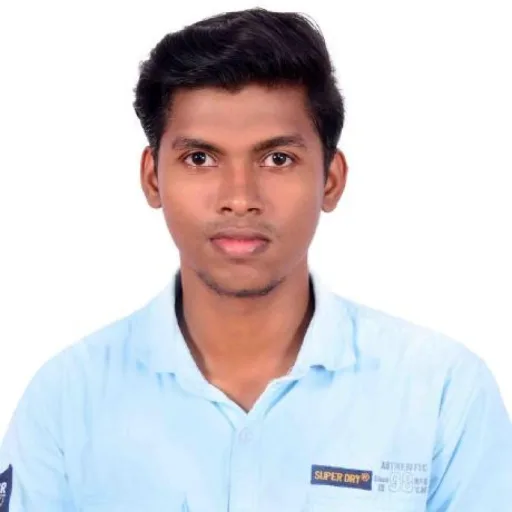
Saravana Raja Ganesan
Software Engineer
Java
Responsive & Cross-browser: 6/10
UX & Visual Polish: 6/10
State Management & Data Flow: 5/10
Invite to interview
Download CVCV
Overview
Technical skills
Timeline
Roles
Overview
A practical frontend app-engineer producing a full-featured offline-first PWA POS application at a solid middle level. The strongest proven skill is building reliable local-first workflows and platform integration (IndexedDB + File System Access + DB migration and kadan payment allocation) demonstrated by DB.migrateCatalogV2, fsdbSet/fsdbGet and DB.payKadan in index.html. Public code shows minimal automated testing, limited a11y attributes and a monolithic single-file structure which constrain scalability and team maintainability.
Phone
Technical skills
Java
Java
Spring Boot
C#
.NET
Mobile
ML Kit
JUnit
Espresso
Android SDK
Flutter
Android
Material Design
Frontend
React.js
Tailwind CSS
Frontend
Analytics
Power BI
Cybersecurity
Microsoft Entra ID
Timeline

Software Development Senior Associate
•
Senior
NTT DATA
•
Full-Time
Built agentic AI and IT automation solutions using Python and Microsoft automation tools. Developed intelligent support bots that auto-resolve tickets and streamline workflows by integrating Azure services, ServiceNow, and Microsoft 365. Worked with Azure Databricks, Azure SQL, and related Azure components to support secure and scalable automation, and used React for an audit/report interface.
Python
Copilot
Power BI
Azure
Azure SQL Database
Databricks
React.js
Project Trainee
•
Junior
OGuru
•
Full-Time
Developed mobile applications using Android Studio with Google ML Kit for object detection and image classification. Used MySQL and worked with ERP-related supply chain concepts, along with Power Platform components for app and data workflows. Implemented full-stack features using Java and SQL, integrating mobile and data-driven functionality.
ML Kit
MySQL
Power BI
Java
SQL

University College of Engineering
Bachelor's Degree •
Information Technology
Middle Frontend Developer
Confidence: High App Engineer
A practical frontend app-engineer producing a full-featured offline-first PWA POS application at a solid middle level. The strongest proven skill is building reliable local-first workflows and platform integration (IndexedDB + File System Access + DB migration and kadan payment allocation) demonstrated by DB.migrateCatalogV2, fsdbSet/fsdbGet and DB.payKadan in index.html. Public code shows minimal automated testing, limited a11y attributes and a monolithic single-file structure which constrain scalability and team maintainability.
UI Component Architecture
3/10
How interface parts are built
Single-file DOM-driven UI with many well-factored helper functions but no component model or reusable component boundary system; pragmatic but monolithic for larger teams.
Responsive & Cross-browser
6/10
Works on all screens and browsers
Solid mobile-first & PWA-oriented choices (viewport, safe-area, Tamil locale, print CSS) and feature-detects modern Web APIs for progressive enhancement.
Performance Optimization
4/10
Speed of the interface
Some targeted optimizations (client-side image compression, local-first persistence, batched filesystem sync) but limited instrumentation, code-splitting or measured RUM/bundle analysis.
Accessibility & Semantics
2/10
Usable for everyone
Accessible patterns exist at basic level (semantic buttons/inputs, visible focusable controls) but no ARIA on custom widgets or explicit keyboard/focus management for complex modals; limited a11y testing artifacts.
State Management & Data Flow
5/10
Managing data in the app
A clear local-state/server-state discipline using a DB object, migrations and offline-first persistence with careful payment allocation logic; lacks request cancellation and strong optimistic-update rollback patterns because it is mostly local-first.
UX & Visual Polish
6/10
Look and feel quality
Strong, practical UX and polish for a mobile-first shop app - skeleton loader, toasts, empty states, PWA install hints, print-friendly receipts and backup flows improve perceived performance and reliability.
Expertise
PWA & Web APIs• Middle
Industries
Commerce• Middle
Technologies
Frontend
 Tailwind CSS
 React.js• since 2025
Recommendations
- Use to build or iterate offline-first PWA features for retail/point-of-sale applications (local backup/restore, export/import, File System Access integration).
- Implement small-to-medium single-page admin/management tools that need robust client-side state, migrations and export flows (inventory, billing, analytics).
- Extend this codebase with modular componentization and automated tests - assign to refactor UI into reusable components and add end-to-end tests.
- Add focused a11y improvements and keyboard/focus management on custom widgets (modals, menus) and iterate performance profiling on heavy lists.
Repositories
The developer's experience in this domain has been verified based on AI analysis of the following repositories:
Middle Mobile Developer
Confidence: Medium Android Engineer
An Android engineer at an early-middle level (Middle, tier_score 3.0) who implements end-to-end mobile computer vision prototypes. The strongest proven skill is on-device computer-vision integration - MainActivity.java wires ML Kit object detection and a TensorFlow Lite model, performs image preprocessing, and annotates results on a Canvas. The work lacks evidence of robust lifecycle/process-death handling, background/Doze-aware processing, offline sync, structured concurrency, and CI/release engineering.
Platform Native Mastery
2/10
Knowing the mobile platform
Basic platform lifecycle handling is present (onCreate, onActivityResult, permission callback) but there is no state restoration, process-death handling, or structured concurrency/cancellation tied to the screen lifecycle.
Evidence
Human-Object-Detection-in-Android-Studio/app/src/main/java/com/example/myapplication/MainActivity.java: onCreate implementation
Human-Object-Detection-in-Android-Studio/app/src/main/java/com/example/myapplication/MainActivity.java: onActivityResult / onRequestPermissionsResult
Mobile UI/UX & Responsiveness
2/10
Smooth mobile experience
UI is functional for the use case with ImageView/Button/TextView and canvas-based annotation, and the code avoids large-decoding OOM via inSampleSize; there is no evidence of adaptive layouts, accessibility, RTL, dynamic type or tablet/foldable handling.
Evidence
Human-Object-Detection-in-Android-Studio/app/src/main/java/com/example/myapplication/MainActivity.java: Canvas drawing of bounding boxes and labels
Human-Object-Detection-in-Android-Studio/app/src/main/java/com/example/myapplication/MainActivity.java: resizeImage and calculateInSampleSize
Performance & Battery
2/10
Speed and battery use
Some mobile performance awareness (image downsampling, native-order ByteBuffer, mapped model file loading) but no measured performance numbers, baseline profiling, background/Doze-aware processing, or memory/leak diagnostics.
Evidence
Human-Object-Detection-in-Android-Studio/app/src/main/java/com/example/myapplication/MainActivity.java: preprocessImage uses Bitmap.createScaledBitmap and ByteBuffer.order(ByteOrder.nativeOrder())
Human-Object-Detection-in-Android-Studio/app/src/main/java/com/example/myapplication/MainActivity.java: uses FileUtil.loadMappedFile for TFLite model
Offline & Data Sync
Working offline and syncing
Not evidenced in public code
Device Integration
3/10
Using device features
Concrete device integrations are implemented - gallery picker, READ_EXTERNAL_STORAGE permission flow, ML Kit and TensorFlow Lite inference - but permission UX lacks rationale/denial-settings flow and there is no comprehensive edge-case handling.
Evidence
Human-Object-Detection-in-Android-Studio/app/src/main/java/com/example/myapplication/MainActivity.java: openGallery uses Intent.ACTION_PICK with MediaStore
Human-Object-Detection-in-Android-Studio/app/src/main/java/com/example/myapplication/MainActivity.java: READ_EXTERNAL_STORAGE permission check/request and onRequestPermissionsResult; imports and use of ML Kit and TensorFlow Lite
Release & App Lifecycle
2/10
Building and publishing apps
Basic build and release configuration exists (compileSdk, targetSdk, proguard files referenced, test runners) but there is no CI, fastlane, crash reporting integration, signing/release pipelines or staged rollout artifacts.
Evidence
Human-Object-Detection-in-Android-Studio/app/build.gradle.kts: compileSdk, defaultConfig, proguardFiles configuration
Human-Object-Detection-in-Android-Studio/settings.gradle.kts: pluginManagement and repository configuration
Expertise
Mobile Performance & Optimization• Middle
Mobile QA & Automated Testing• Junior
Technologies
Android
 Java• since 2023
 .NET
.NET
 JUnit
JUnit
 Spring Boot• since 2023
 Android SDK
 Flutter• since 2026
 Espresso
 ML Kit• since 2024
 Material Design
Recommendations
- Use this developer to build Android prototypes that integrate on-device ML and computer-vision features - image capture, preprocessing, inference and on-screen annotation.
- Assign them to harden permission and lifecycle flows - add runtime rationale, settings redirect for denials, and state restoration for process death; consider migrating to Kotlin with structured concurrency for cancellation-aware image pipelines.
- Have them add measurable performance work and testing - baseline profiles (cold start, inference latency), automated instrumentation tests for detection flows, and CI pipelines for repeatable releases.
Repositories
The developer's experience in this domain has been verified based on AI analysis of the following repositories:
Intern AI/ML Engineer
Confidence: Low Generalist
A developer with minimal publicly available code evidence and an Intern-level profile. No concrete implementation artifacts are present in reviewed human-authored files, so no proven ML engineering skill can be identified. The public materials do not show tests, deployment, experiment tracking, or custom model/training code, so advanced or production ML work is not evidenced.
Model Architecture & Training
How well models are designed and trained
Not evidenced in public code
Data Pipeline & Feature Engineering
How data is prepared for models
Not evidenced in public code
Experimentation & Evaluation
How results are measured and tested
Not evidenced in public code
MLOps & Deployment
How models are shipped to production
Not evidenced in public code
Computational Efficiency
How efficiently computing resources are used
Not evidenced in public code
Research Depth & Innovation
Depth of research and new ideas
Not evidenced in public code
Recommendations
- Add a small, self-contained human-authored example that includes model code, a training script, and a README describing inputs and outputs so skill can be evaluated.
- Include clear experiment tracking and evaluation artifacts such as train/validation splits, metrics computation, and at least one saved model checkpoint.
- Add unit tests and a CI configuration to demonstrate engineering rigor and reproducibility.
- Document data preprocessing and include a small sample dataset or data schema so data pipeline skills can be assessed.
Repositories
The developer's experience in this domain has been verified based on AI analysis of the following repositories: